 O'Connell Bridge and the River Liffey
 For a few days while Stephanie was visiting we made a short trip to visit Dublin and some country side of Ireland. Here's what we did....
Day 1 (Sunday): Sunday morning we had to get really early at 3:30am and took buses to Heathrow airport for a flight at 7:50am to Dublin. We got into Dublin at 9am and took the Airlink bus into the city and then walked to our hostel to drop off our bags. First thing we went to O’Connell Street near the hostel. This is where The Spire, a huge silver needle in the middle of the street. We then took a bus to see the Guinness Storehouse and went on a tour. It started with an atrium that had the original lease signed by Arthur Guinness in December 31, 1759 for 9,000 years. He also got water rights. The water used is from the Wicklow Mountains not the River Liffey (passes through Dublin) as some people believe. Next we went into a room about the ingredients (barley, hops, water, and yeast). 2/3 of Ireland’s production of barley is used by Guinness. The yeast used to brew the beer is supposedly from the same strand since Arthur Guinness started some of which is kept in a safe in the Director’s office. Through the rest of the exhibit there were videos of the Brewery Master explaining the process of brewing. The barley gets roasted and we were able to try some. It wasn’t very good really. We also watched a video of a cooper making the old barrels used to store Guinness. The first Guinness sent to the US went to South Carolina. There was an exhibit on the history of advertising, commercials (had videos from every decade) and Guinness stuff. A pint of Guinness is included in the tour so we last went up to the top floor Gravity Bar that had great views of Dublin. Steph and I had a pint of coke instead but Travis made sure to enjoy the Guinness for us. It was an interesting visit to the Storehouse but they sure love Guinness there. They call it Black Gold. In pubs it will be called the black stuff. We then took the bus back to O’Connell Street and the hostel to get some rest before then visiting St. Patrick’s Cathedral. In the park next to the Cathedral is said to be where the well was that St. Patrick used to baptized converts to Christianity. A church has been in that location since the fifth century. The current church was built in the thirteenth century. Jonathan Swift was Dean at the Cathedral between 1713 and 1745 and is buried in the church. We ate dinner at a little pub that had an old man band playing some great music.

Christ Church Cathedral

Guinness Storehouse
 inside St. Patricks
 Taking a nap... it had been a long day
 St. Patrick's Cathedral
I tend to take far too many notes on these sorts of things if you haven’t already noticed so here we go again…
Our guide was an Irishman named Peter and he started out telling us a brief history of Ireland. St. Patrick was kidnapped and used as a slave working in the Wicklow Mountains for 5 years before he returned to Britain where he God came to him in a dream telling him to return to Ireland (389 AD). He was meant to come and convert the people to Christianity. Once back he meets with the High King at a bonfire in order to try and explain the Holy Spirit. The King doesn’t understand so St. Patrick uses the 3 leaf clover to explain the holy trinity which did work to explain Christianity to the King and then the people. There are only 2 days in Ireland that you can’t purchase alcohol which are Good Friday and Christmas. If you can imagine it used to also be no alcohol on St. Patricks Day. 842 AD was the first arrival of Vikings on 60 long boats but 4 years later that were kicked out. It was for another 12 years that they came back with 2000 boats but the Irish King held them off and ruled over them. In 1169 the Normans arrived from Britain and settled in Dublin. The edge of Dublin was called the Pale where it was civilized anything outside of that was “beyond the Pale” home of barbarians. After a while the “barbarians” and Normans start to get along and want separation from Britain and if 1554 was the first rebellion against British rule. The jolly guy that King Henry VIII was then crowned himself King of Ireland. In 1690 was the Battle of Boyne between the Jacobites (Catholic King James) and Williamites (King William of Orange in England). This led to the Treaty of Limerick stating that the Catholic Jacobites could keep their land and other rights as long as they swore allegiance to William. I hadn’t written anything on these so had to do some Wikipedia searching to fill in the gaps. 1801 was the abolishment of the Irish Parliament and complete rule again by Britain. During the 19th Century there was famine and lots of immigration. 1916 was the Easter Rising where during Easter week there was uprising in Ireland against British rule and forming an Irish Republic. This started the movement for Independence that would come in 1922. Ireland became part of the European Community in 1973. The 1980’s saw recessions and more immigration but in the 1990’s was a boom in the economy until 2007. There’s Ireland in a nutshell according to our guide but he definitely filled in a lot with the rest of the tour…
 Lady "Justice"
We then went into the square of Dublin Castle. There were two statues. The statue of a man represents fortitude and the woman statue is lady justice. However lady justice has a few odd things, first it she is not blindfolded. Her sword is drawn and the scales in her left hand, one side is sheltered by her arm and other side is exposed, whenever it rains it will fill with water and move making them unequal scales. Dublin Castle was built by King John of England as a fortification against the Irish rebels. The Records Tower is the only tower left from the original Dublin Castle, it was finished in 1230. The walls are 4 meters deep and tower was first used as a prison. The first person to escape the tower was Red Hugh O’Donnell who was the son of the leader of the O’Donnell family, rebellions against England. The British wanted a hostage to suppress the family. The British lured the 15 year old Red onto a boat with some red wine (at the time there was a Prohibition except alcohol could be bought off a boat). He was hit over the head and when he woke up was in the prison. He was kept there for 6 years until he burrows out through the sewage (like in Shawshank Redemption!) and walks 30 miles to the mountains in the snow. His father than gives him the head of the family. Red then starts the 9 Years War with the British along with the O’Neil family and Spain. In 1601 was the Battle of Kinsale when the Spanish that were coming to help the Irish landed in Southern Ireland and were surrounded by the English before the Irish made it down from the North. Another turning point in the war to benefit of the English was the Flight of the Earls when 1,000 leaders of the Celtic families left for Europe to raise money and an army but most never returned. Behind Dublin Castle is the garden. There was originally a pond in this spot called Duvlin which translates to Dark Pool or Black Pool. The garden had stone eels with eyes as spotlights to make the garden into a helicopter pad. From the back of Dublin Castle could be seen the several architectural styles of the castle from left to right some strange Lego bright colors, Georgian, mideval, and neo Gotchic.
 River Eel/lights for helicopter pad
 Weirdest thing I've ever seen going down the street... This was after the Guinness Storehouse don't know why this picture popped in this spot..
 Dublin Castle
Our next stop was Christ Church Cathedral which is a protestant church. The church originated in 1032 by the Vikings. In 1171 the Normans beat the Vikings in a battle to control Dublin and then rebuilt the church. It had also been used as a marketplace for a time. It was renovated and restored in the 19th century by Henry Rowe (whiskey distillery). St. Patrick’s was renovated by Guinness. At Christ Church there was a man who was cleaning the organ and came across a dead cat stuck and then further up finds a dead mouse, these two are now stuffed and on display. There was a stone layout around the church showing the shape and size of a typical Viking home that about 20 people would live in. Originally there were around 200 plots/homes. In the 1980’s they found the original settlement of the Vikings very well preserved which they thought may have been because the river had flooded this settlement so the Vikings had to abandon it and move. The spot where this was all found is now the new city council building. Before it was built there was protesting against it since it would be built right over the preserved settlement. These protests were called the Wood Key Protests but the Supreme Court found in favour of the city council.
We then started to head into the Temple Bar area and had a short break in a pub called the Purty Kitchen. The Temple Bar started as a sand bar along the River Liffey for loading and unloading goods, owned by a man named Temple. It is now a very vibrant area with bars and markets. It is set up in a medieval street pattern of having one main street with many small side streets breaking off.
 Ha'penny Bridge
 Memorial for a fake man
We went through a narrow street to get to the River Liffey. The river has had a bad reputation as being very polluted and that you can’t swim in it. Neither of these is very true. The river is dark and smells because it is tidal (like the Thames in London). We crossed over the Ha’penny Bridge. Before there was the bridge ferries would take people across the river but then they became in disrepair. The city told the ferry drivers to either fix their boats or build a bridge so they built the Ha’penny Bridge. They charged people to cross the bridge which was originally very wobbly. Harland and Wolf, the men who built the Titanic, fixed the wobbly bridge. We headed along the river to O’Connell Bridge which wider than it is long. On this bridge is a small plaque for Father Pat Noise. There was a lot of suspicions over him around his death in 1919 because he, his horse and buggy all went over the bridge into the river and his body was never found. In 2006 the city council tried to find out about the plaque and Father Pat Noise but never found anything and determined it all never existed. They then took the plaque off but people started to put flower there instead so then put this plaque for a fake man and a fake death back up.
 Trinity College
We crossed over O’Connell Bridge back to the South side of the river to Trinity College. It was first founded in 1592 by Queen Elizabeth I and is the oldest school still being used. We stood in a square surrounded by the Exam Hall (also used for graduation), the Dining Hall, and the Graduate Memorial Building. Also in the square was the College Chapel that is multi denomination and if you graduate there and get married within 5 years after you can get married in this chapel. There is also a monument in the middle of the square and if a first year student walked under it they will fail all their exams. In 1800 Catholics were then allowed to study at Trinity College. The Catholic Church feared that if Catholics attending this once only Protestant school they would be corrupted so had to get a letter from the Bishop to say it was alright for them to attend. This didn’t stop until the 1970’s. Some famous students of Trinity College include Bram Stoker (wrote Dracula), Jonathan Swift, Samuel Beckett, and Courtney Love shockingly.
 Old Library at Trinity College
In the Old Library is held the Book of Kells. This book has the first 4 books of the Bible written in Latin by monks on Iona Island. There was a worry that the Vikings would have destroyed this book so it was taken to Kells. It has been in the Old Library since the 1660’s. The Brian Boru's harp is also held in the Old Library which is the one used in the Guinness design. In 1922 wanted the symbol of Ireland to be this same harp but had to use a mirror image instead because Guinness had a trademark on the original Brian Boru's harp. George Lucas wanted to use the Long Room in the Old Library for a scene in Star Wars but the school wouldn’t allow it so he used a model instead. Trinity College than tried to get money from the movie for this but I think didn’t win anything.
 Possible inspiration for the White House?
Leinster House is the Irish Parliament building original built in 1748 for a private residence. At that time the area north of the river was very nice but he said “where I go, they will follow” which is exactly what ended up happening. In 1815 the house was bought and two wings were added which became the National Library and National Museum of Architecture. The original building is claimed to be the inspiration for the White House.
We then walked to a park with a statue of Theobold Wolftone who came from a long line of Irish rebellion families which was unusual become from a rich Protestant family. He wanted the Catholics and Protestants to work together and created the United Irish Man Group. In 1798 he led a rebellion against the British that failed but led to the National Flag. The green stands for the Catholic Nationalist, orange for Protestant Unionist, and white for the peace between. Also in the park is the Famine memorial. The famine was from 1845 to 1847 when the potato crop was ruined. Most of the population was dependent on the potato for food. Before the famine there were 8 million people in Ireland and afterward it had dropped to 5 million. Over 1 million died and over 1 million left Ireland. The famine did not have to happen because during the entire time food was still being shipped away. This all happened while London still ruled over Ireland.
Our guide finished the tour with the story of the 1916 rising. During the second half of the 19th Century there was home rule movement wanting to separate from England. In 1914 London Parliament finally allows an Ireland Parliament. When WWI breaks out and the Irish are encouraged to fight for the British Army and many die. After the war a new group wants to have total independence not just home rule anymore and decide to plan the rebellion on Easter Sunday of 1916 but don’t get the guns they were meant to. The leader of the rebels, Pearce, plans instead for Easter Monday to have 1500 people take over buildings in the city. The British send a ship up the River Liffey to O’Connell Street to bomb the General Post Office. By Saturday the rebellion stopped because many civilians were dying and by then the citizens of Dublin were against the rebellions. The British signed 90 death warrant for members of the rebels, 15 were completed, which led to more people supporting the rebel independence. In 1919 was the war for independence that lasted 2 years. In 1921 was the Anglo-Irish Treaty which created the Ireland Republic. January 1922 the Irish Constitution was signed and Michael Collins was elected President.
After our tour we went straight to the nearby train station to get a train to Howth, a small town north of Dublin on the coast. The train ride was only about 30 minutes. We spent a couple hours wondering around the small town mostly along the harbour. Fishing boats were coming in attracting seals that were patiently waiting for food to drop. The views were great and made for some really good pictures. We ate dinner in Howth at The Bloody Stream. Travis and I had scampi and Stephanie had fish and chips.
 Howth- The Bloody Stream Restaurant

 Howth harbour

Day 6 (Tuesday): We finally were able to go on our Wild Wicklow Tour! We went back to O’Connell Street to meet the bus and our guide Steven. I wasn’t able to take many notes during this tour since most of the information was told while on the moving bus which my stomach can’t handle writing on. We went from O’Connell Street over the River Liffey passing Trinity College and the statue of Maggie Malone the big breasted oyster seller. On O’Connell Street is a statue of Father Matthew who during the temperance movement got 6,000 people to stop drinking. At the Viking settlement that was found near Christ Church 2.5 million artefacts were discovered. Our guide said that Oscar Wilde also attended Trinity College.
We drove through South Dublin seeing the Oscar Wilde statue and passing many Georgian era/style buildings and homes. South Dublin is the more post area since the Earl or Duke of Leinster moved there and the rich followed. We went through the coastal towns of Dun Loaghaire, Dalkey, and stopped in Sandycove at the sandy cove that people swim daily. This stop had views across Dublin Bay to the Dublin Port and Howth. There were several snorkelers and swimmers which I cannot imagine doing because the water was freezing. At this stop was also a 40 foot tall stone tower, many were built along the coast or around the pale. This tower was the last place James Joyce was seen before he left Ireland. He left for the US because at this tower he got into a debate with someone who then shot at him. We then got back on the bus to Avoca Handweavers for a short snack break at a little cafe shop with gardens. Here was the only mature Monteray cypress tree in the world which was really incredible.
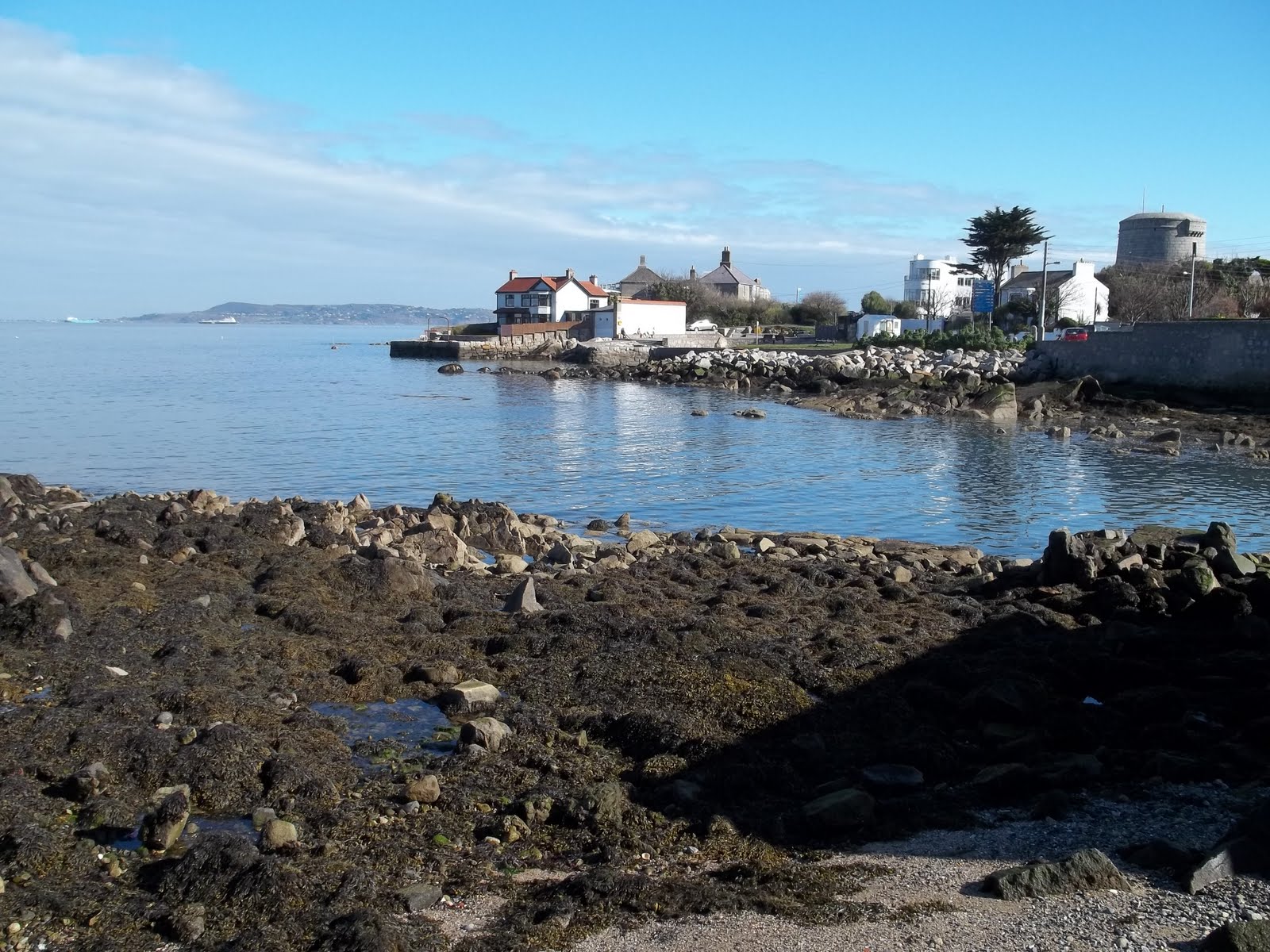 Sandycove
 only mature Monteray cypress tree
 Wicklow Mountains Park
We didn’t stop again until we got into the Wicklow Mountains. The mountains are covered in bog which is thick peat moss and heather a purple blooming plant. We had a few stops in the mountains. One was the bridge from the movie P.S. I Love You. It didn’t look as good as in the movie because the heather wasn’t blooming at the time like in the movie. We stopped to see a lake that looks like a pint of Guinness. Our guide gave us all a free shot of Jameson whiskey to warm us up. Lunch was at Lynhams in Laragh before we went on to Glendalough.
 sideways P.S. I Love You bridge
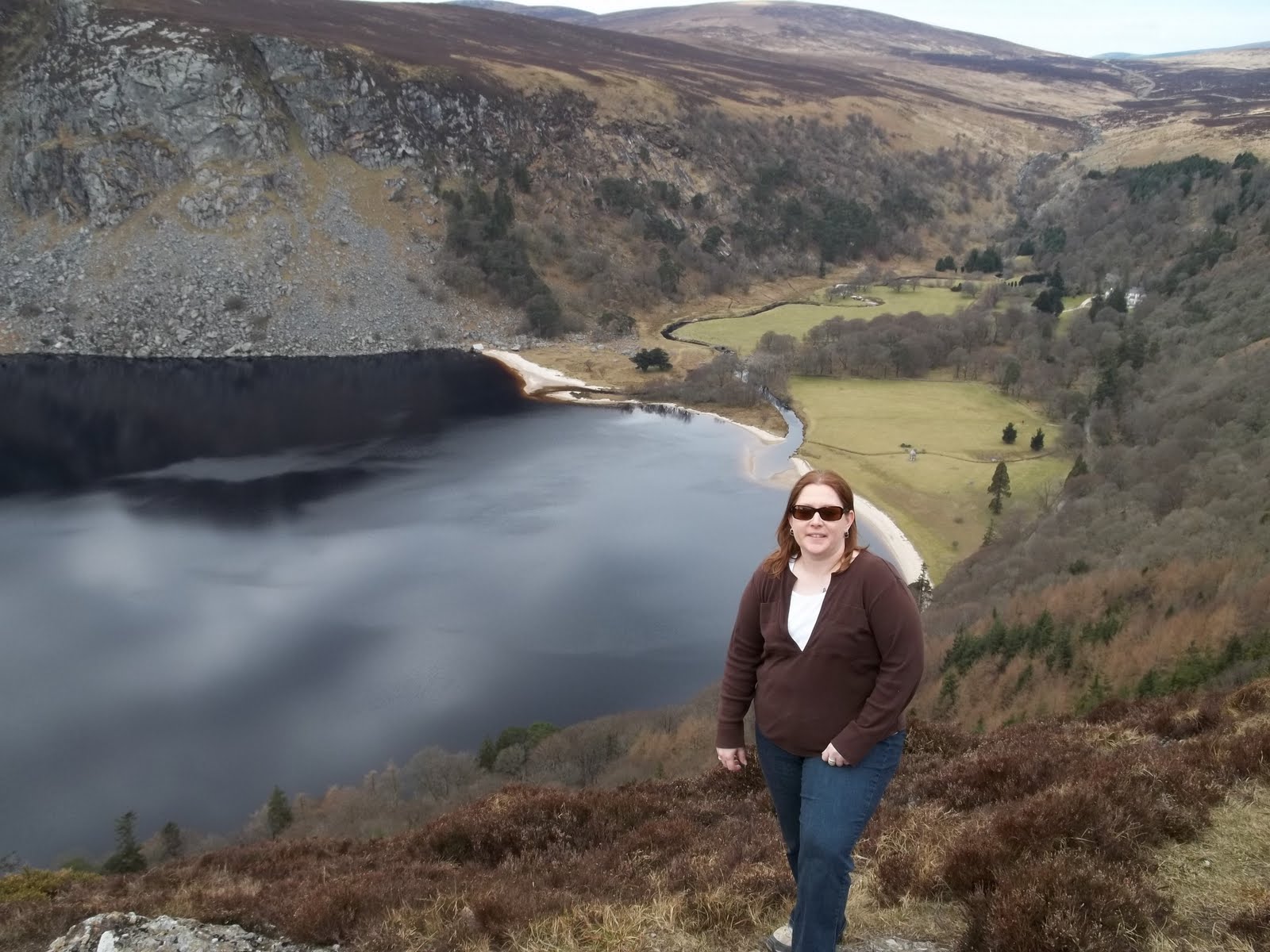 The Guiness pint looking lake
 Cute Irish guide Steven describing Glendalough
Glendalough is a 6th Century Monastic settlement. It has a cemetery, Round Tower, small church, and a home for the monks. We had a couple hours on our own to walk around this area and take a path to lake. If a single woman walks around the Round tower three times they will soon get married. The church no longer had a roof and lying around the inside were some very old headstones from the 17th and 18th centuries. Travis, Stephanie, and I went across the creek to walk to the lake. By the time we had gotten there we had to leave and quickly get back to the bus before we left. Then was the long bus trip all the way back. This was definitely one of the best tours I had ever been on. I was a bit worried we were going to spend too much on the bus but this was definitely not the case. I’m glad we were still able to do this tour since there wasn’t room the day before. Once we were back in Dublin we had to leave straight to the airport. Ireland was amazing and we would love to back to see more especially the smaller towns and country.
Oh some Irish talk or Gaelic words... loch means lake, ville means village, and glen means valley.


Ireland was amazing! I'm glad we had gotten a chance to go there with Stephanie. Hopefully we can go back again to see another part!


